Our services for production plant qualification
Hardware, process, software – one evidence package instead of three separate document worlds.
A production plant is not a single device. It is a stack of field devices, control, process-control software, manufacturing operations and enterprise applications. EU GMP Annex 15 requires documented evidence that plant is suitable for its intended use. Where software decides, Annex 11, 21 CFR Part 11 and a risk-based GAMP 5 approach apply as well.
We join equipment qualification, process validation and CSV or CSA instead of producing three separate document worlds. The interactive pyramid further down this page shows the test focus on each layer. The parent Equipment and Facility Qualification offering remains the frame for DQ, IQ, OQ and PQ.
Regulations: EU GMP Annex 15 · Qualification and Validation EU GMP Annex 11 and 21 CFR Part 11 GAMP 5 2nd Edition CSA · Computer Software Assurance
Risk-based validation
Use CSA for targeted validation
Quality instead of quantity: CSA (Computer Software Assurance) scales validation effort to risk, not to page count. Product quality and safety stay at the centre, not the volume of documentation. The next section covers how AI speeds up the remaining busywork.
Accelerate documentation
Use AI efficiently and save time
Modern AI support saves time in plant qualification by taking on the documentation busywork efficiently: it checks cross-references, generates or reconciles a Traceability Matrix, compiles a glossary and abbreviation list, and keeps the version history current. CSA still means quality over quantity; AI is the accelerator for evidence work, not a substitute for qualification judgement.
Specialist hours freed this way go into engineering, testing and plant understanding, for example into URS, risk analysis and commissioning. With AI agents and workflows we accelerate those documentation steps; GxP decisions remain with your qualification owners.
Three strands, one qualification subject
Clarify your qualification strategy or jump straight to the pyramid?
Book an initial consultation Go to automation pyramidAnlagen-Wegweiser
Welche Anlage steht im Fokus?
Wählen Sie die Ausgangslage für Produktionsanlagen-Qualifizierung.
Greenfield-Qualifizierung
Qualifizierungsstrategie, Terminplan und Nachweisdokumentation von DQ bis PQ.
Equipment in der Linie
Pressen, Extruder und Peripherie qualifizieren und in Change Control einbinden.
Nachqualifizierung
Bestehende Anlagen nach Audit-Finding oder Umbau wieder in den validierten Zustand führen.
Reference: Case story: production equipment. Read case story
Our approach in GxP projects: from planning through release – each step delivers evidence you can present in QA review and audit. View GxP consulting in five steps
Regulatory basis
Primary sources only. Each link states why it applies to qualifying production plants.
-
EudraLex Volume 4: EU GMP Guide
Official collection of EU GMP chapters and annexes. Entry point for Annex 11, Annex 15 and Chapters 3 and 5.
-
EU GMP Annex 15: Qualification and validation
Core text for DQ, IQ, OQ, PQ, requalification and the plant life cycle since 1 October 2015.
-
EU GMP Annex 11: Computerised Systems
Applies as soon as SCADA, MES, LIMS or ERP create or store GxP data: validation, audit trail, access control.
-
EU GMP Chapter 3: Premises and Equipment
Requirements for rooms and equipment, including calibration of measuring and control devices.
-
EU GMP Chapter 5: Production
Production requirements that assume qualified plant and controlled processes.
-
21 CFR Part 211 Subpart D: Equipment
US cGMP for equipment. § 211.68 addresses automatic, mechanical and electronic equipment including computers.
-
21 CFR Part 211 Subpart F: Production and Process Controls
US cGMP for written production and process-control procedures. Complements Annex 15 where the plant must deliver a reproducible process.
-
21 CFR Part 11: Electronic Records; Electronic Signatures
Applies to electronic records of the control and operations layers, not to the mechanics of the plant itself.
-
FDA: Computer Software Assurance (CSA)
Risk-based testing guidance for production and quality-management software under 21 CFR Part 820 (medical devices). The pyramid toggle follows that method; it is not an EU GMP annex for medicines.
-
ISPE GAMP 5 Guide, 2nd Edition
Method for computerised systems, V-model and risk assessment. Not law, but the usual state of the art in audits. Official purchase page, not a pirated PDF.
-
ASTM E2500: Specification, Design and Verification of Pharmaceutical and Biopharmaceutical Manufacturing Systems and Equipment
Science- and risk-based verification of manufacturing systems; GAMP 5 Appendix S1 aligns with it.
-
ISA-95 / ANSI/ISA-95: Enterprise-Control System Integration
Defines layers and interfaces between manufacturing control and enterprise software; IEC adopts the model as IEC 62264.
-
PIC/S publications (GMP guide PE 009, PI 006 qualification)
PIC/S GMP is practically aligned with EU GMP. PI 006 covers qualification and validation from an inspector’s view.
-
ICH Quality Guidelines (Q7, Q8, Q9, Q10)
Q7 API GMP, Q8 pharmaceutical development, Q9 quality risk management, Q10 pharmaceutical quality system: the risk core for CSA-style testing and the VMP.
-
AMWHV: German ordinance on manufacture of medicinal products and active substances
German implementation of GMP duties for manufacture and testing. Complements the EU GMP Guide; it does not replace Annex 15.
-
AMG: German Medicinal Products Act
Legal basis for manufacturing authorisation and marketability in Germany. Technical qualification sits in Annex 15 and the AMWHV.
Related services
The DQ-to-PQ frame is described on Equipment and Facility Qualification. Computerised systems of the control and operations layers are covered in Computer System Validation (CSV). Operation, hardening and the plant IT network sit in IT Administration. A FAT/SAT-near reference without customer names is the case story on presses and extruders.
FAQ: Production plant qualification
Production plant reference projects
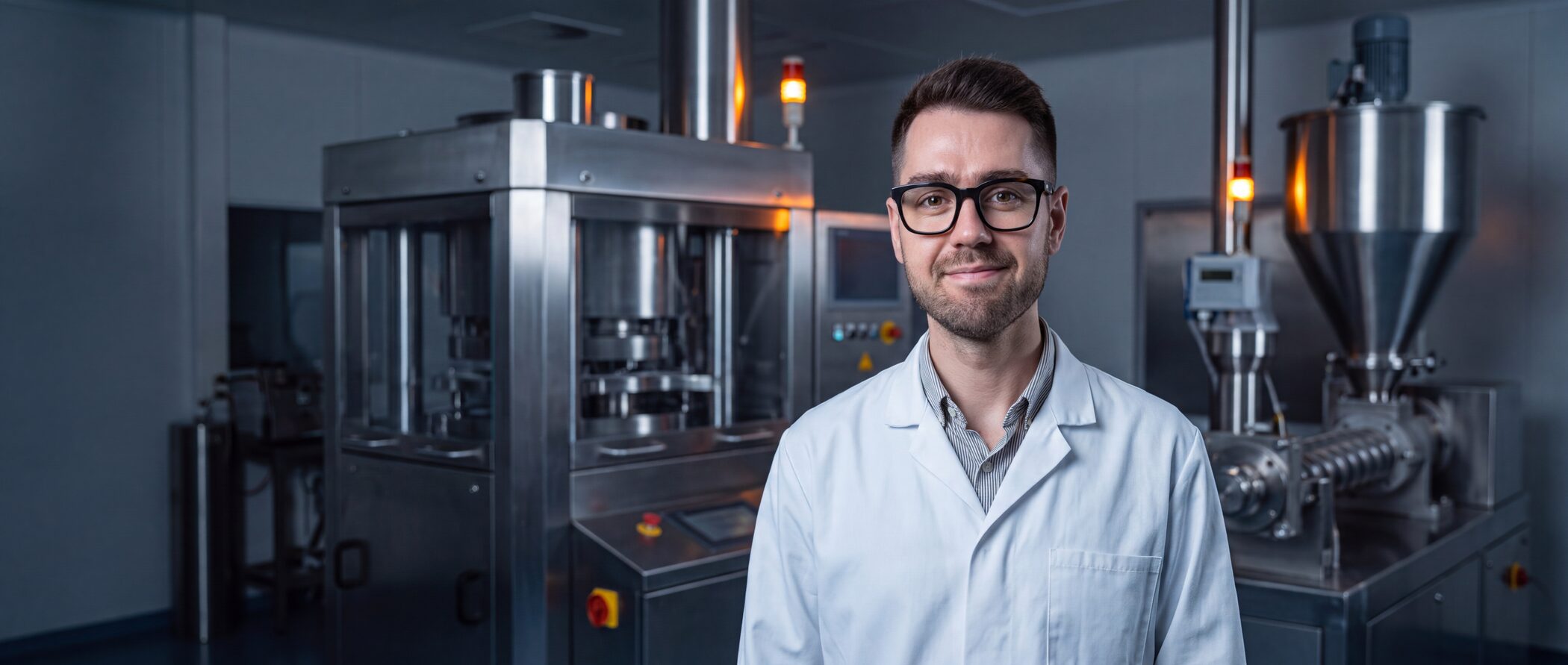
Presses, extruders, and production environments through to GxP release.
 Production plants
Presses and extruders
Retrospective qualification of a tablet press and FAT/SAT plus on-site qualification of extruders.
View case story Production plants
NanoDrop One
Spectrophotometer released for GxP use in four months, including PCR devices and Validation Manager.
View case story Production plants
Spectrophotometer lab IT
Hardening and qualification: kiosk mode, PowerShell audit trail, backup, and virtualisation.
View case storyAutomation pyramid for plant qualification
Five layers, one qualification object. Choose a layer, by click, keyboard, or as an accordion on the phone. The CSV/CSA switch changes the test focus in the GAMP 5 V-model.
Signal flow from the field layer to batch release. Hover lifts a layer; Enter or click opens the qualification focus.
Qualification focus
Layer in detail
Field layer: plant hardware. Without calibrated sensors and tested loops, any higher-level software is only decoration.
CSV on level 0
- DQ of field devices against the URS (ranges, materials, explosion protection where relevant)
- IQ: layout, utilities, wiring, nameplates, spare-parts list
- Calibration concept and loop tests from sensor through PLC to display
- OQ of actuators, valves and drives in operating and limit states
Highlighted in the GAMP 5 V-model
CSA on level 0
- Risk by impact on product quality: test critical loops with scripted protocols
- Use supplier evidence (FAT, calibration certificates) for standard field devices
- Unscripted challenge tests where the function is obvious and the risk is low
- Documented critical-thinking evidence in the qualification report instead of checklist volume
Highlighted in the GAMP 5 V-model
Control layer: the PLC runs sequence and control logic. Code, I/O list and controller hardware are separate qualification objects.
CSV on level 1
- Hardware qualification of the controller (IQ of cabinet, CPU, I/O cards)
- FDS of the control logic against the URS
- Code review, version control, comparison of the download to the approved version
- Signal tests and OQ of interlocks, recipes and safety chains
Highlighted in the GAMP 5 V-model
CSA on level 1
- Scripted tests for critical control functions (batch start, interlock, reject)
- Standard I/O and diagnostics with unscripted tests plus the supplier library
- Code review in proportion to category (GAMP category 5 stronger than configured blocks)
- PLC changes always through change control, never ad-hoc downloads
Highlighted in the GAMP 5 V-model
Process-control layer: SCADA and HMI make the plant operable. Audit trail, user management and alarms sit here: classic Annex 11 topics.
CSV on level 2
- URS and FDS for visualisation, recipes and history
- IQ of servers, clients, time synchronisation and backup
- OQ: user management, roles, audit trail, alarming, electronic signature where used
- PQ of operation under production conditions
Highlighted in the GAMP 5 V-model
CSA on level 2
- Highest assurance for audit trail, access control and alarm-relevant displays
- Configured displays with low quality risk: unscripted, but with configuration evidence
- Do not adopt the supplier OQ of the SCADA platform unseen: check the GxP project context
- Record data integrity of the history (ALCOA+) explicitly in the risk assessment
Highlighted in the GAMP 5 V-model
Operations layer: MES and LIMS run orders, electronic batch records and laboratory results. This is where a batch is documented in a GxP-capable way.
CSV on level 3
- Full life cycle: URS, FDS, configuration, IQ, OQ, PQ
- Validation of electronic batch records and deviation workflows
- ALCOA+ for data capture, corrections and release steps
- Interfaces to SCADA, LIMS and warehouse: each with its own IQ/OQ
Highlighted in the GAMP 5 V-model
CSA on level 3
- Scripted: EBR integrity, release, specification checks, audit trail
- Configured master-data screens with low risk: unscripted plus configuration evidence
- Do not treat supplier CSA as the operator validation 1:1
- Weight interface risks (wrong status into the ERP) higher than visual reports
Highlighted in the GAMP 5 V-model
Enterprise layer: the ERP is rarely a GxP system in its entirety. GxP-relevant are the interfaces and processes that carry batch status and release.
CSV on level 4
- URS of GxP-relevant ERP interfaces (material, batch, status, hold)
- IQ/OQ of data mapping and error scenarios
- Evidence of batch-release processes including authorisations
- Supplier and hosting assessment where operation is outsourced
Highlighted in the GAMP 5 V-model
CSA on level 4
- Do not validate the whole ERP: define and justify the GxP perimeter
- Scripted: status change, hold, release, interface failures
- Documented exclusion of finance and purchasing modules outside the perimeter
- Treat change control for interface mappings as you would for plant
Highlighted in the GAMP 5 V-model
Document and scope configurator
Which layers exist on your production plant or sit in the project scope? The plan lists typical qualification documents. It does not replace a risk-based assessment in the VMP.
Derived document plan
Please select at least one layer.
Request a qualification project
The button opens the browser print dialog. Save the matrix as PDF from there. Server-side email delivery of the file is not connected.
ISA-95 / IEC 62264 model note
The pyramid follows the five-level model common in German-language plant engineering (field, PLC, SCADA/HMI, MES, ERP). ISA-95 / IEC 62264 is the related standard for integrating enterprise and control systems. In the ISA view, sensing often sits at Level 1 and PLC/DCS at Level 2; SCADA is sometimes placed with manufacturing operations. We keep the URS pyramid and name the difference so audits do not fail on the layer number.