Project Management for Regulated Environments – GxP Experts
As cube one GmbH, we understand ourselves as a responsible partner who supports you in the successful implementation of your IT projects, qualifications, and validations, ensuring that your projects are comprehensively planned, professionally executed, and closely monitored – all within the timeframe and budget you specify.
You focus on your business, we focus on your project.
Our Expertise:
- Project Management in the Context of Your Company:
We comprehensively accompany your projects – from conception and planning through execution to successful completion, relying on pragmatic and lean management methods. Throughout this process, we competently and reliably pursue your interests and goals. - Communication as the Key to Success: We maintain a close, effective information exchange, handle stakeholder management and expectations management, organize meetings, workshops, and lessons-learned events for you, and are happy to moderate and document these. We communicate fairly, solution-oriented, with appreciation, and in an international environment.
- Individual Project Management: We use modern tools to make project management as transparent and comprehensible as possible, such as Jira, Confluence, and Microsoft Project. Regardless of the strategies and methods we employ for your project – whether classic, agile, or hybrid – you will be involved in all relevant steps and always retain full control over your endeavor.
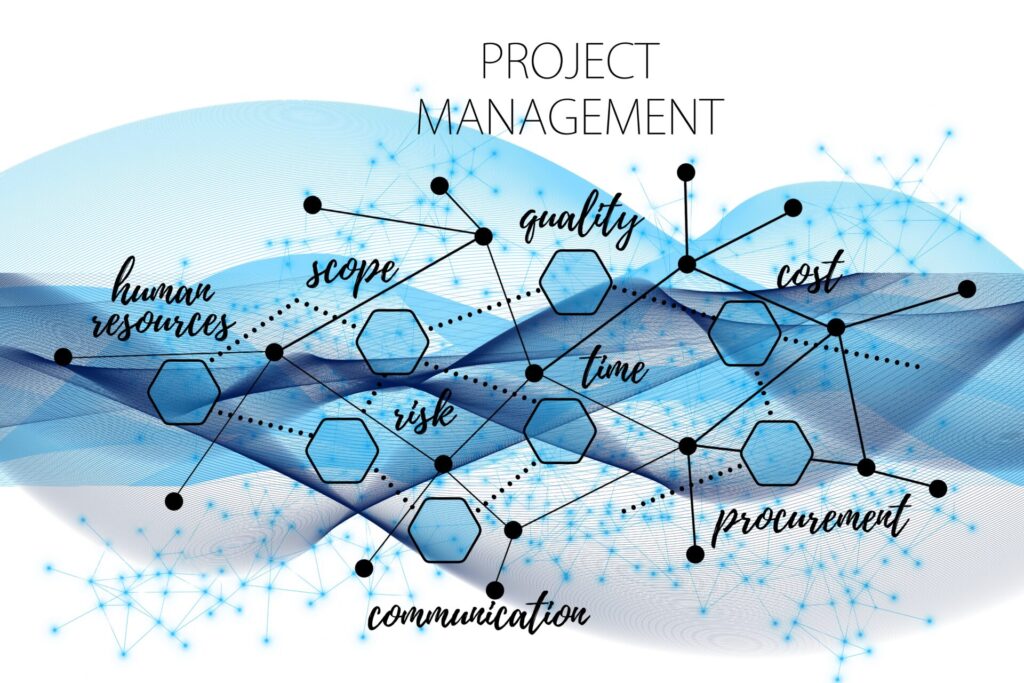
- Our Competencies: We cover all relevant areas of project management – from initial planning through control and monitoring to successful completion. Our service spectrum includes, among others, Project Management Office (PMO), project leadership, monitoring, controlling, reporting, quality management, and procurement.
Your Advantage:
By outsourcing your project management to cube one GmbH, you can fully concentrate on your core competencies and business. We ensure that you are informed about the project status at all times and that your projects are successfully guided to their goal, taking into account the key pillars of time, cost, and resource planning.
Service Portfolio:
- Individual project management tailored to your needs
- Completely planned, professionally executed, and closely monitored project coordination
- Project Management Office as a central coordination and organizational hub
- Organization of meetings, workshops, and lessons-learned events
- Regular, open, and appreciative communication
- Comprehensible and sustainable documentation of your project, creation of information materials for your business
Contact us today to learn more about our customized project management, so that you can implement your project as smoothly and successfully as possible with us.

Structured Planning and Clear Project Goals
Benefit from our experience in planning and managing diverse IT projects in the GxP Life Science industry with all its industry-specific, regulatory requirements.
We support you in your challenges throughout every project phase and create a robust roadmap according to your framework conditions through precisely tailored and efficient project management.

Transparency and Reporting
We guarantee comprehensive transparency throughout all project phases. Using modern project management tools, we document and control the progress of your project seamlessly. Our regular status reports provide you with precise insights into budget progression, resource utilization, and potential risks

Sustainable Project Implementation
Systematically documenting knowledge and anchoring it within the company means sustainable project implementation. Through a culture of continuous learning, experiences and best practices are captured, enabling future projects to benefit from acquired knowledge.
Together, we secure valuable experiential knowledge, make successes reproducible, and shape future-proof project work.
FAQ on Project Management in the GxP Environment
GxP is a collective term for quality guidelines in regulated industries, particularly in pharmaceuticals and life sciences. The “x” stands for various practice areas:
- GMP (Good Manufacturing Practice) – Manufacturing
- GLP (Good Laboratory Practice) – Laboratory work
- GCP (Good Clinical Practice) – Clinical trials
- GDP (Good Distribution Practice) – Distribution
- GAMP (Good Automated Manufacturing Practice) – Automated systems
The GxP environment requires strict compliance with regulatory requirements to ensure product quality, data integrity, and patient safety.
The key differences are:
- Documentation Requirements: Every project phase must be comprehensively documented and approved. Retrospective documentation is not acceptable.
- Validation Obligation: Systems, processes, and changes must be validated before going live to prove they work as intended.
- Quality Assurance (QA) Involvement: QA must review and approve all critical documents and decisions.
- Change Control: All changes must follow a formal change control process, even minor ones.
- Audit Readiness: All project documentation must be audit-ready at any time and must be retained for many years (often 10-30 years).
Documentation is the foundation of GxP projects. The principle is: “If it’s not documented, it didn’t happen.”
Critical documents include:
- Project Plan: Scope, timeline, resources, risks
- Validation Plan: Validation strategy and acceptance criteria
- Requirements Specifications (URS): Functional and technical requirements
- Risk Assessments: Identification and evaluation of risks
- Test Protocols and Reports (IQ/OQ/PQ): Proof of system functionality
- Change Control Records: Documentation of all changes
- Validation Report: Summary and release of the system
All documents must be version-controlled, approved, and archived.
Validation is the documented proof that a system, process, or method consistently performs as intended and meets all specified requirements.
In GxP project management, this means:
- Prospective Validation: Testing before going live
- Concurrent Validation: Validation during operation (for existing systems)
- Retrospective Validation: Evaluation based on historical data
Validation includes:
- Installation Qualification (IQ)
- Operational Qualification (OQ)
- Performance Qualification (PQ)
The system may only be used in production after successful validation and QA approval.
a GxP project manager should possess:
Technical Knowledge:
- Understanding of GxP regulations (FDA, EMA, ICH guidelines)
- Knowledge of validation processes (CSV, qualification)
- Familiarity with GAMP 5 and risk-based approaches
Project Management Skills:
- Certifications (PMP, PRINCE2, Agile/Scrum)
- Experience with waterfall and agile methods
- Strong stakeholder management
Industry Experience:
- Practical experience in pharma, biotech, or medical devices
- Understanding of audit processes
- Knowledge of SOPs and change control procedures
Soft Skills:
- Strong communication skills
- Attention to detail and precision
- Ability to work under regulatory pressure
Change management follows a formal Change Control Process:
- Change Request: Submission of a formal change request
- Impact Assessment: Analysis of effects on:
- Validation status
- GxP compliance
- Project timeline and budget
- Other systems and processes
- Risk Assessment: Evaluation of risks associated with the change
- Review and Approval: Assessment by relevant stakeholders (PM, QA, System Owner)
- Implementation: Controlled execution in test environment
- Testing: Verification that change works as intended
- Documentation: Complete documentation of all activities
- QA Release: Final approval by Quality Assurance
- Communication: Informing all affected parties
No change without approval – this is a fundamental principle in GxP projects.
Yes, agile methods are possible but require adaptations to meet GxP requirements:
Agile-GxP Hybrid Approaches:
- Validated Sprints: Each sprint includes validation activities
- Definition of Done (DoD): Includes GxP compliance criteria
- Continuous Documentation: Documentation is created in each sprint, not retrospectively
- QA Integration: QA participates in sprint reviews and releases
- Automated Testing: Regression tests ensure continuous compliance
- Risk-Based Prioritization: Critical features are validated first
Challenges:
- Balancing flexibility with documentation requirements
- Ensuring complete traceability
- Managing change control in short iterations
Many pharmaceutical companies now successfully use “Agile Validation” approaches.
An Audit Trail is an electronic record that chronologically and comprehensively documents all activities in a system or project:
Contents:
- Who performed an action (user identification)
- What was done (activity description)
- When it was done (timestamp)
- Why it was done (reason, where applicable)
- What was the previous state (original value)
Importance in GxP Projects:
- Regulatory Requirement: Required by 21 CFR Part 11 and EU Annex 11
- Data Integrity: Ensures ALCOA+ principles
- Traceability: Complete reconstruction of all project activities
- Audit Readiness: Evidence during inspections
- Incident Investigation: Analysis of deviations and errors
Audit Trails must be:
- Tamper-proof
- Automatically generated
- Retained for the required period (often 10+ years)
- Regularly reviewed
SOPs are binding work instructions that describe how specific activities must be performed in GxP projects:
Key SOPs in GxP Project Management:
- Project Management SOP
- Change Control SOP
- Document Management SOP
- Validation SOP
- Deviation Management SOP
- CAPA (Corrective and Preventive Action) SOP
- Training SOP
Importance:
- Standardization: Ensuring consistent execution
- Compliance: Fulfilling regulatory requirements
- Training: Basis for employee training
- Audit Evidence: Demonstrating established processes
- Quality Assurance: Minimizing errors through clear guidelines
Project managers must:
- Know and follow all relevant SOPs
- Ensure team members are trained on applicable SOPs
- Document adherence to SOPs
- Initiate deviations if SOPs cannot be followed
Non-compliance with SOPs can lead to serious regulatory consequences.
At the end of a GxP project, the following steps occur:
Validation Report:
- Summary of all validation activities
- Confirmation that all acceptance criteria are met
- Documentation of deviations and their resolutions
- Final recommendation for system release
QA Release:
- Quality Assurance reviews and approves all documentation
- Formal release for production use
- Generation of the release certificate
Handover to Operations:
- Transfer of responsibility to the system owner
- Training of end users
- Provision of all documentation (SOPs, manuals, training materials)
Archiving:
- All project documents are archived according to retention requirements
- Typically 10-30 years, depending on product lifecycle
- Secure, tamper-proof, and retrievable storage
Post-Implementation Activities:
- Ongoing monitoring and periodic review
- Change control for future modifications
- Re-validation planning (typically every 3-5 years)
The system is now in “validated state” and must be maintained accordingly throughout its lifecycle.
Our Reference Projects
To give you better insight into our work and expertise, explore selected reference projects now.
Contact us today for personalized consulting on project management.